
Gulfstream G400: Inside the Certification Journey, and What Buyers Should Take Away
JF
JFA Aviation | November 7, 2026

A moment at the NBAA-BACE outdoor aircraft display.
Our NBAA-BACE visit offered a closer look at the aircraft and the details that matter to prospective owners. The G400 display and flight deck photographs shared here bring that perspective into focus. AIN's interview adds a different view: the engineering work behind the aircraft on display.
A business jet on a show display can look ready for its next owner. The work behind that aircraft tells a much bigger story.
In Aviation International News' November 3 report, Gulfstream Puts G400 Test Aircraft Through Paces En Route to Certification, Gulfstream's Scott Evans explains how a four-aircraft flight-test program brings performance, systems and cabin evaluation together. It is a useful look beyond the polished exterior and into the work that precedes delivery. [1]
For JFA Aviation clients, the takeaway is practical: understand what a development milestone proves, what it does not prove, and how the aircraft could fit the trips you actually fly.
Watch the AIN interview
Watch the original AIN interview on YouTube. Published November 3, 2026. Internet access is required for the embedded interview.

The Gulfstream G400 display during JFA's NBAA-BACE visit.
Four aircraft, different jobs
Evans describes four airplanes in the G400 flight-test program. The first three focus on systems and performance certification. The fourth is the interior certification aircraft, intended to bring cabin readiness forward alongside the rest of the program. [1, 0:22 to 1:09]
That division matters. A successful first flight is a major milestone, but it is not the whole development story.
In the interview, Evans describes years of laboratory work before flight, followed by airborne validation. He explains that individual test aircraft have assigned responsibilities, including performance and envelope expansion, avionics, mechanical systems and electrical power. He also discusses low-speed stall characteristics, high-speed flutter work, icing and cold-weather evaluation. [1, 1:18 to 2:55]
The point is not one dramatic final test. It is the combined evidence produced by aircraft doing different jobs.
Watch the G400 display visit clip in the JFA Yacht & Ship edition of this article
From the visit: the G400 display. This is show footage, not certification-test footage.
The cabin is part of the engineering story
The interior aircraft is more than a place to choose finishes.
Evans explains that Gulfstream plans to operate it in environments resembling customer use while collecting data and refining the product. That makes the cabin part of the development process, not simply the decoration that follows it. [1, 3:00 to 3:40]
AIN's separate October 19 written report adds detail: the fully outfitted G400's first flight departed Dallas Love Field, lasted 2 hours 46 minutes and reached 48,000 feet. Its 11-passenger layout, arranged across two-and-a-half cabin zones, supports evaluation of cabin systems, functionality and in-flight comfort. Those figures describe that test aircraft and flight, not a guarantee for every customer configuration. [2]
For a prospective owner, this is a reminder to look beyond seat count. Ask how the cabin will work during the trips that matter to you: working in flight, resting, traveling with colleagues or bringing family aboard.
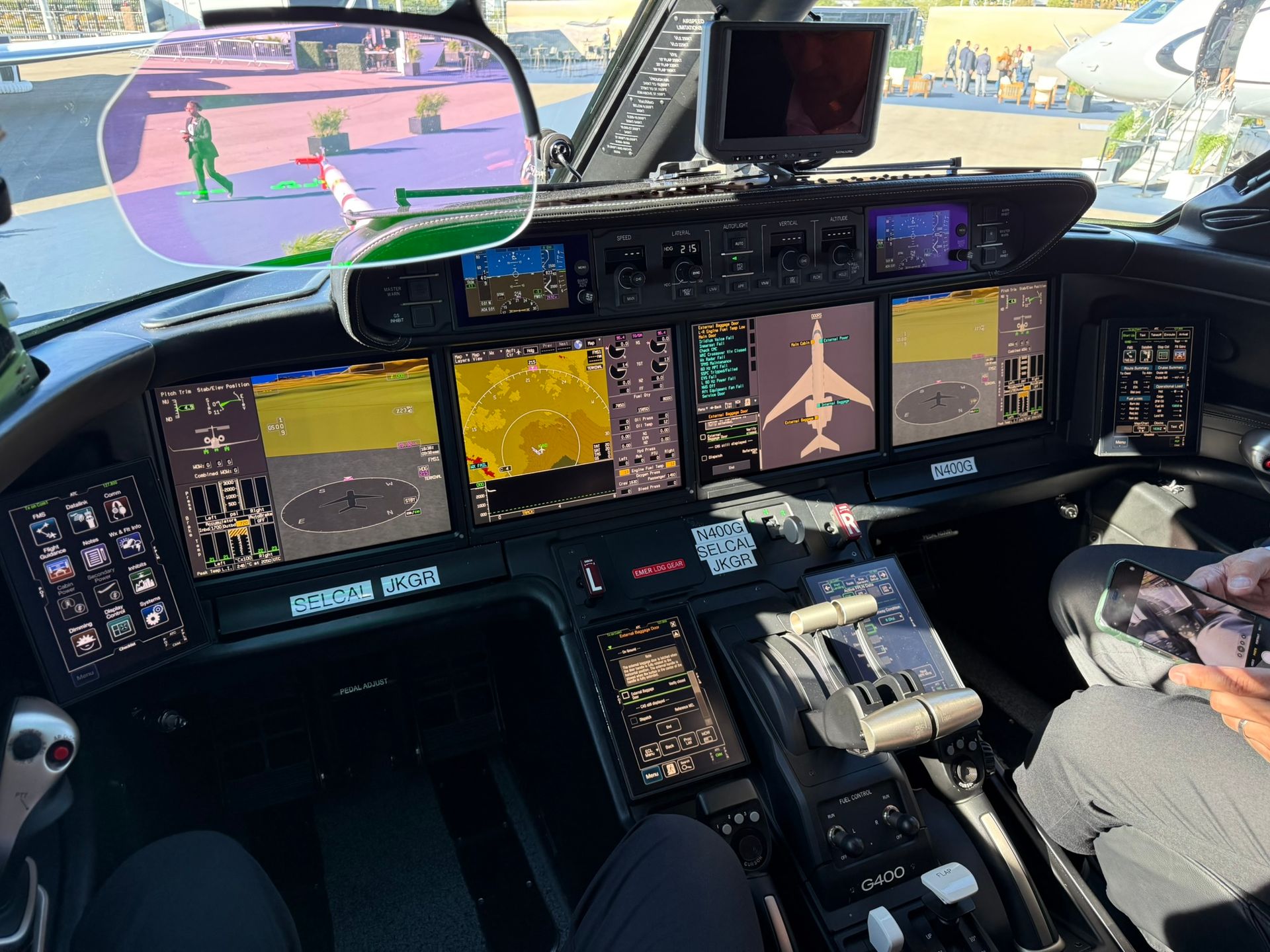
A closer look at the G400 flight deck on display.
A speed record has a purpose, and a limit
AIN's interview reports that an experimental G400 flew from Miami to Las Vegas in 4 hours 8 minutes at Mach 0.89 on its way to NBAA-BACE. [1, 3:41 to 3:59]
Evans explains Gulfstream's approach to these demonstrations: measuring from takeoff to landing, rather than simply between two overflown points, gives customers a more relevant view of what an aircraft accomplished on a particular trip. [1, 4:10 to 5:38]
That is valuable information. It is not a promise that every flight on the same route will take the same time. Weather, routing and the details of the mission still matter.
Nor should a speed record be read as a certification announcement. AIN's November 3 report describes engineers working toward certification. Its subject is the testing journey, not an announcement that approval has been granted. [1]
What this means for your next aircraft decision
At JFA Aviation, we believe the conversation should begin with your mission, not the excitement around a new model.
Our earlier NBAA-BACE buyer and seller guide makes the same point: trip length, passengers, runways and budget should drive the airplane. Our article What Actually Sells in the 2026 Business Jet Market also emphasizes mission fit, records and a clear maintenance story.
If the G400 is on your watch list, start with these questions:
• Which routes must the aircraft cover, with how many passengers and how much baggage?
• Which cabin features will genuinely improve your most frequent trips?
• What operating, support and ownership assumptions need to be validated?
• How flexible is your acquisition timeline, and what alternatives should you compare?
A thoughtful purchase separates demonstrated progress from future expectations. The G400 interview is worth watching because it shows how much work sits behind the aircraft buyers see on the display line.
More from the NBAA-BACE visit
The photographs and short clips below add context from the wider show visit. They are not all G400 media, and they do not document AIN's interview. Aircraft models are identified only where confirmed.

At the NBAA-BACE entrance, with #NBAA2026 visible.

A nose-mounted probe on a display aircraft, with a G600 visible behind it. The foreground aircraft's model is unconfirmed.
Flight Deck wayfinding at NBAA-BACE.

A G800 display detail from the wider visit. This is not the G400.

Another moment at the outdoor display. Aircraft model is not assigned from this image.

Aircraft exteriors on the display line. Individual models are not assigned here.

Inside a display aircraft cabin during the visit. Aircraft model is unconfirmed.

A G700 flight-deck visit, identified by the pedestal marking. This is a different model from the G400.

A group moment on the ramp during the visit. No aircraft model is assigned from this image.
Other flight-deck perspectives
Watch the G700 cockpit visit clip in the JFA Yacht & Ship edition of this article
G700 cockpit visit clip. This is a different model from the G400 discussed above.
Watch the head-up display demonstration clip in the JFA Yacht & Ship edition of this article
Head-up display demonstration during the visit. Aircraft model is not assigned here, and the demonstration is not evidence of flight.
Additional album footage
Watch additional NBAA-BACE visit footage, clip one in the JFA Yacht & Ship edition of this article
Additional NBAA-BACE visit footage from the supplied album, clip one. No aircraft model or activity is asserted here.
Watch additional NBAA-BACE visit footage, clip two in the JFA Yacht & Ship edition of this article
Additional NBAA-BACE visit footage from the supplied album, clip two. No aircraft model or activity is asserted here.
Let's talk about where you want to go
Considering an aircraft purchase or sale? Tell JFA Aviation about your routes, passengers, budget and timing. We can help turn the conversation from a model name into a mission-led plan.
Contact Capt. James Fachtmann at [email protected] or call 954-732-5825.
For clients whose plans extend from the airport to the waterfront, our sister brand JFA Yacht & Ship brings the same focus on careful due diligence and personal service to yacht ownership. Whether your next chapter takes you into the air or out to sea, start with the journey you want to make.
Sources
1. Aviation International News, Gulfstream Puts G400 Test Aircraft Through Paces En Route to Certification, November 3, 2026. Article | Original interview. Interview passages cited above are paraphrases, not direct quotations.
2. Kerry Lynch, Aviation International News, Gulfstream Adds Outfitted G400 to Flight-test Program, October 19, 2026. Read the report. Only the publicly accessible opening paragraphs were used.